

National
“Inside NPTI: Evaluating the Diploma in Personal Training”
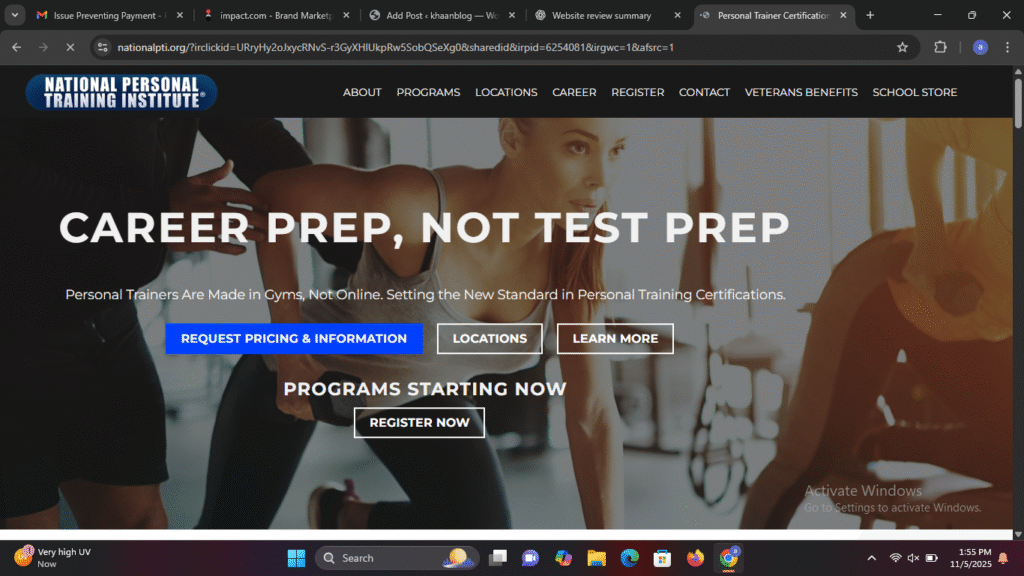
Here’s a detailed review of the website page for the National Personal Training Institute (NPTI) “Become a Personal Trainer” program. I’ll cover strengths, weaknesses, and key take-aways to help you assess whether this program is a good fit.
✅ What works well
- Clear value proposition
The page leads very strongly with the idea: “Become a Personal Trainer” and emphasises that their program is a diploma rather than just a “certification”. The claim is that “a personal training certification is just a test — we are a personal training school” (from line 178) which positions them as offering something deeper and more substantial. (nationalpersonaltraininginstitute.sjv.io)- This helps differentiate them in a crowded market of short online certifications.
- It appeals to someone who wants more than just a standard credential.
- It signals a more professional approach (“licensed through the Department of Education”) which adds credibility. (nationalpersonaltraininginstitute.sjv.io)
- Hands-on / hybrid / flexible model
They highlight that the program includes virtual/online components and in-person/hands-on learning (“hybrid, virtual & in-person classes”). (nationalpersonaltraininginstitute.sjv.io)- This flexibility is good for people who may be working, or balancing other commitments.
- The mention of finishing “in as little as four months” if time is of the essence is also a strong selling point (line 178) (nationalpersonaltraininginstitute.sjv.io)
- Also they say they offer “Physical textbooks or eBooks depending on which you prefer” and include self-assessments, quizzes, worksheets, checklists, etc. (nationalpersonaltraininginstitute.sjv.io)
This shows attention to the student experience and learning resources.
- Career support & added value
They highlight post-program support: “Lifetime Job Placement”, “60hr Mentorship Program”, “Networking”, “Lifelong Correspondence with any Questions”. (nationalpersonaltraininginstitute.sjv.io)- That helps shift the offering from purely academic/training into career-outcome territory.
- Particularly for a vocational/trainer role, having job-placement and mentorship is a strong plus.
- Nationwide/international reach
They claim the program is “offering … nationwide, Canada and internationally.” (nationalpersonaltraininginstitute.sjv.io)- That broad reach is good for flexibility and for someone in the UK (as you are) to consider – though we’ll need to check UK applicability later.
- They also note veteran benefits and financing options, which indicates some level of infrastructure and support. (nationalpersonaltraininginstitute.sjv.io)
⚠️ Areas to probe / weaknesses
- Generic marketing language
- Although their value proposition is clear, much of the page uses broad statements like “we train countless individuals”, “world’s leading health and fitness professionals” etc. (nationalpersonaltraininginstitute.sjv.io)
- The claims are qualitative, not quantified. There’s little specific data about graduate outcomes (e.g., % employed within X months, average salary, exact curriculum hours).
- For someone investing time and money, more concrete evidence would build trust.
- Diploma vs. certification: clarity needed
- They emphasise that a diploma is “far above a personal trainer certification” (line 159) and that certification “is just an exam”. (nationalpersonaltraininginstitute.sjv.io)
- It’s important to clarify: what recognition does this diploma carry? Is it locally recognised in the UK? What regulatory/licensing requirements exist where you are? If the diploma is US-based, how does it translate for UK employment or gym certification?
- The site is US-centric (US phone number, US address). While they say “Canada and internationally”, they don’t provide specific details about UK operations, licensing, or accreditation.
- Cost transparency missing
- They mention “Flexible and Affordable Payment Options” and “it cost a lot less compared to degree programs” (line 180) (nationalpersonaltraininginstitute.sjv.io)
- But the actual cost isn’t listed on that page (or at least not in the lines shown). You’d want to know: tuition, materials, any lab/kit fees, travel for in-person sessions, etc.
- Without cost figures, hard to assess ROI.
- International applicability and credentials
- If you’re based in London, UK, you’ll want to ask: Does this diploma meet the UK fitness industry standards? Is it considered equivalent to something like UK gym trainer certifications (e.g., Level 2/Level 3 Personal Trainer award via a UK provider)?
- Will UK gyms accept the credential? Will you need additional UK-specific certifications/insurance/licensing?
- The site doesn’t clearly address international abandonment or UK-specific recognition.
- Hands-on component unclear for remote/international students
- They emphasise “hands-on learning … training and educating others and others will be training you.” (nationalpersonaltraininginstitute.sjv.io)
- But for someone overseas or unable to attend in-person sessions, how is this arranged?
- Are there UK campuses or partner facilities? Are the in-person components local or US-based only?
- If everything is remote, the “hands-on” part may be limited; if there is in-person, you’ll want logistics.
📝 Key sections & what they tell us
- “What makes us different” (lines 147-152) emphasise being a “personal training diploma” rather than a typical certification. They emphasise licensed through the Department of Education and trained by world-leading professionals. (nationalpersonaltraininginstitute.sjv.io)
- Under “What Do You Get From Our Personal Trainer School” (lines 194-207): they list practical materials and resources: chapter study guides, textbooks/eBooks, virtual learning, practice quizzes, exercise programs, anatomical guides, client forms, etc. This is a very positive sign: they’re equipping you with actual tools you will need. (nationalpersonaltraininginstitute.sjv.io)
- Under “What are the benefits …” (lines 171-179): they note the flexibility (virtual/hybrid/in-person), potential business opportunities, and affordable payment options. Good to see the orientation toward entrepreneurial possibilities. (nationalpersonaltraininginstitute.sjv.io)
- The “Register”, “Learn More”, “Request Pricing” calls to action appear throughout, which shows they are geared toward conversion but may require you to contact them for full details. (lines 131-139 etc) (nationalpersonaltraininginstitute.sjv.io)
🎯 Fit for you (London / UK context)
Since you’re based in London, here are some tailored considerations:
- Recognition & accreditation: UK gyms typically recognise UK-specific personal trainer qualifications (e.g., industry bodies like CIMSPA – Chartered Institute for the Management of Sport and Physical Activity). You should check whether NPTI’s diploma is recognised by UK employers and whether you’ll need a UK version or additional certification to work locally.
- Logistics for in-person/hands-on training: If NPTI’s hands-on training is US-based, you may need to travel (which adds cost/time). If there are partner campuses in the UK or Europe, that would be better. Confirm location & accessibility of in-person modules.
- Cost/currency & ROI: Convert tuition and any extra fees into GBP, and compare with UK-based programmes (which may have lower travel/logistics cost). Consider how much you could realistically earn as a UK personal trainer and how quickly you’ll see payoff.
- Insurance/licensing: In the UK you’ll need professional indemnity and public liability insurance to work as a trainer, and you’ll need to understand how this diploma fits into that. Also check against UK’s requirement for Level 3 PT qualification (where applicable).
- Business opportunity: They emphasise business and entrepreneurship (lines 173-174). If you plan to train privately, start your own business or work with clients independently, this orientation could be valuable. But check how well that entrepreneurial guidance translates for UK market dynamics (tax, business setup, client acquisition, local regulations).
🔍 Final verdict
Overall, the NPTI offering appears to be high-quality in terms of structure, resources, and support. The strengths – a more in-depth diploma rather than just a quick certification, flexible format, good resources, and career support – are compelling. If you are serious about becoming a full-fledged personal trainer (rather than just doing the minimum), this could be a strong option.
However, given your UK location, there are a few important caveats to resolve before you commit:
- Confirm the recognition/acceptance of the diploma in the UK gym/fitness industry.
- Clarify costs, including travel/in-person modules (if required), and how they compare with UK alternatives.
- Ask about the hands-on component: where it takes place, how often, mode (in-person vs remote) and whether it is accessible in the UK or Europe.
- Check if you’ll need additional UK qualifications/licensing beyond the diploma to work in London.
- Evaluate ROI: how quickly can you start earning as a PT in London, and whether the investment is reasonable given local salary levels.
If those points check out well, then this is likely a good choice. If some of them raise doubts (e.g., the diploma isn’t recognised locally, or the cost/travel burden is high), you may want to compare UK-based PT schools or programmes.
If you like, I can look up UK equivalents and compare cost/recognition to help you decide between options. Would that be helpful?
